 My account

 Services

Early years learning resources
The early years foundation stage (EYFS) statutory framework states the standards that school and childcare providers must meet for the learning, development and care of children from birth to age five.
The EYFS framework:
- sets the standards that all early years providers must meet to ensure that children learn and develop well
- ensures children are kept healthy and safe
- ensures that children have the knowledge and skills they need to start school
The framework is for:
- school leaders
- school staff
- childcare providers
- childminders
- out-of-school providers
It relates to:
- local authority maintained schools
- non-maintained schools (those not maintained by a local authority)
- independent schools
- academies and free schools
- nurseries
- private nursery schools
- pre-schools and playgroups
- childminding
Communication and language resources
The EYFS framework states the development of spoken language underpins all seven areas of learning and development.
The number and quality of their conversations with adults and peers is crucial. Commenting on what children are interested in or doing will be effective in helping build their language.
Reading to children and getting them to use and embed new words in a range of contexts, will give them the opportunity to thrive. Through conversation, story telling and role play, children will use a rich range of vocabulary and language structures.
Resource | Organisation | Description |
|---|---|---|
Famly | Playful ways to encourage speech and language development. | |
BBC | Activities and play ideas to develop language skills. | |
NHS | Helping to give children the best start in life. | |
National Literacy Trust | Tips and activities for families to complete at home. |
Physical development resources
The EYFS framework states physical activity is vital for a child's all-round development. It enables them to pursue happy, healthy and active lives.
Gross and fine motor experiences develop through early childhood. These develop a child’s strength, co-ordination and awareness of their position. This is done through tummy time, crawling and play with both objects and adults.
By creating games and ways for play both indoors and outdoors, adults can support children to develop their:
core strength
stability
balance
spatial awareness
co-ordination
agility
Gross motor skills are the basis to develop healthy bodies and social and emotional wellbeing. Fine motor control helps with hand-eye co-ordination. This is later linked to early literacy. Children develop control and confidence through:
play with small world activities
puzzles
arts and crafts
the use of small tools
Resource | Organisation | Description |
|---|---|---|
GOV.UK | Learn about core strength and co-ordination as part of the EYFS. Includes advice from experts and activities. | |
GOV.UK | Learn about gross motor skills as part of the EYFS. Includes advice from experts and activities. | |
GOV.UK | Learn about fine motor skills as part of the EYFS. Includes advice from experts and activities. | |
GOV.UK | Infographic showing the physical activity needed for general health benefits for children under 5. | |
GOV.UK | A report from the Chief Medical Officers in the UK. Covers the amount and type of physical activity people should do to improve their health. | |
WHO | Booklet around the WHO guidelines on physical activity, sedentary behaviour and sleep for children under 5 years of age. | |
NHS | Active hobbies and sports to get the family moving. | |
Think! | Road safety teaching resources for children. | |
Department for Health and Social Care | The Activate programme by Joe Wicks is aimed at children from 4 years old, and is a great way to promote and support families to have fun and get active. |
Personal, social and emotional development (PSED) resources
The EYFS framework states PSED is crucial for children to lead healthy and happy lives. Its fundamental to a child's cognitive development.
There are important attachments that shape a child's social world. Strong, warm and supportive relationships with adults help children to learn about their own feelings and those of others. Children should be supported to:
manage emotions
develop a positive sense of self
set themselves simple goals
have confidence in their own abilities
persist and wait for what they want
direct their attention as necessary
Through guidance from adults they'll learn how to look after their bodies. The includes healthy eating and being able to manage their own needs. With other children they'll learn how to make friends, co-operate and resolve conflicts. These will help them achieve at school and in their later life.
Resource | Organisation | Description |
|---|---|---|
TastEd | Healthy eating resources for nurseries, childminders and activity club providers. | |
First Steps Nutrition Trust | A digital guide to provide support to families to help them to get the most out of the Healthy Start scheme in England. | |
NHS | Overview of the 4-in-1 pre-school booster vaccine. This is offered to children from the age of 3 years and 4 months to boost their protection against four serious conditions. These are: diphtheria, tetanus, whooping cough and polio. | |
Skcin | National accreditation programme for nursery and pre-school settings. Free resources to help in the duty of care to safeguard children against UV and prevent skin cancer through education. | |
Child Accident Prevention Trust | Information around child accident prevention. | |
Brake | Help for schools and families to make a difference to road safety. | |
Childnet | Advice about screen time and top tips. | |
NHS | YouTube video for the 'How to wash your hands' song. | |
BBC | Help to develop a child's language skills. Simple activities and play ideas. | |
GOV.UK | Example menus and useful guidance for early years settings to help meet the EYFS requirements for food and drink. | |
NHS | Help to buy food and milk. | |
Barnsley Council | The Rose Vouchers for fruit and veg project helps families on low incomes to buy fresh fruit and vegetables. This supports them to give their children a healthy start in life. | |
First Steps Nutrition Trust | Advice about eating well in the first year. | |
NHS | Advice around what’s really in the food your family eats. | |
Brush DJ | App that makes brushing your teeth fun. Available on the App Store or Google Play. | |
BBC | Tooth brushing song and a game for children to earn a tooth brushing badge. | |
Henry | Video which looks at what we can do to help our children grow up with healthy teeth. | |
British Society of Paediatric Dentistry | Videos to inspire children to look after their teeth. | |
Food - a fact of life | Activity ideas and resources to support teaching young children about food. | |
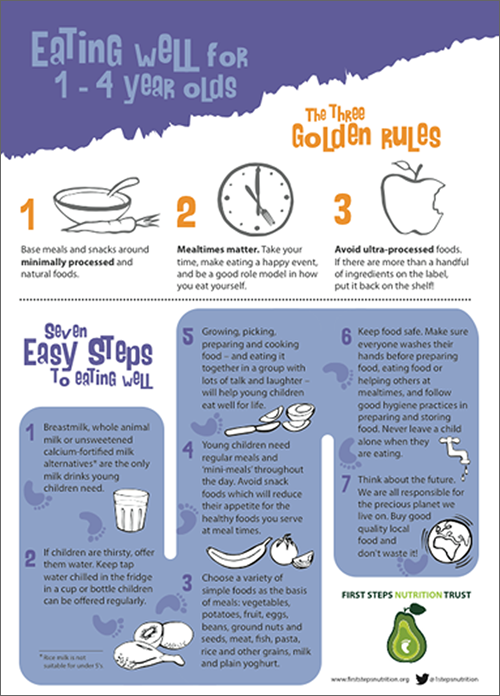
First Steps Nutrition Trust | Poster showing seven easy steps to eating well. | |
Food - a fact of life | Presentation for early years about vegetables. | |
GOV.UK | Report about feeding young children aged 1 to 5 years old. |
Oral health resources
Resource | Organisation | Description |
|---|---|---|
Oral Health Foundation and others | A guide on how to brush children's teeth and support good oral health was created collaboratively by a number of organisations. | |
Barnsley Council | Guide to promoting lifelong good habits and useful resources. | |
Barnsley Council | Kind to Teeth campaign posters to print off and display. For further information on Kind to Teeth or to request images for social media or Kind to Teeth training please email oralhealth@barnsley.gov.uk | |
Barnsley Council | Guide on how to help with supervised toothbrushing. | |
PHSE association | Dental health lesson materials for EYFS and SEND. Lesson plans are free but require registration to access them. | |
SUDSS Smile Squad | Video resources from a team of dental students at the University of Sheffield including how to brush teeth and what to expect when you go to the dentist. |
Further resources
Resource | Organisation | Description |
|---|---|---|
Lullaby Trust | Hub containing guidance, training and resources. | |
NHS | Easy ways to eat well and move more. | |
Health for under 5s | Advice around health for children under 5 years old. | |
Barnsley Council | Information around the Barnsley breastfeeding welcome scheme and how to join. | |
Barnsley Council | Guidance for early years settings to create a food, drink, oral health and physical activity policy. | |
Supplementary policy creation guidance for early years settings | Barnsley Council | Supplementary guidance for early years settings creating a food, drink, oral health and physical activity policy. |
